
You don’t need to read this page to build with Universal Accounts. Everything described here happens automatically under the hood. This page is for developers who want to understand what’s happening beneath the SDK before integrating. If you just want to ship, jump straight to our Web Quickstart.
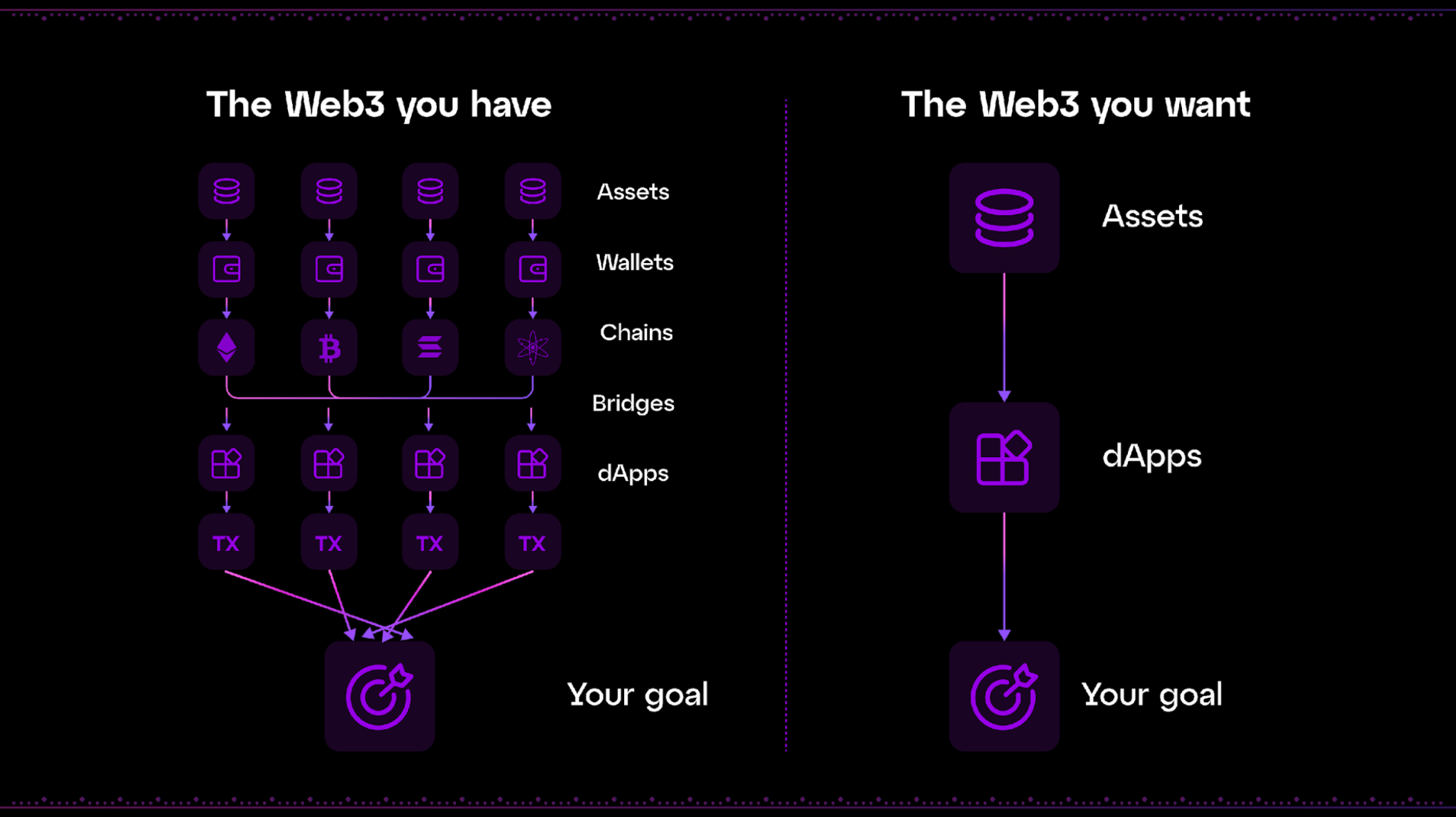
Chain Abstraction visualized.
With Universal Accounts, users and developers interact with Web3 as if it were one unified environment.
What This Means for Users
- One account and balance across all chains.
- Use any token as gas on any transaction.
- No bridges or chain switching required.
What This Means for Developers
- Build your dApp on one chain, serve users from all of them.
- No need to manage cross-chain deployments.
- Unified liquidity, handled automatically in the background.
For a semi-technical, action-packed Universal Accounts showcase, watch our official cinematic explainer!
Powered by Universal Liquidity
Universal Liquidity is the mechanism that enables chain abstraction. It allows Universal Accounts to fulfill user actions without requiring them to bridge or manually move assets across chains. It routes funds across solvers with liquidity on supported networks based on the user’s intent, allowing them to interact with all chains as if they were one.How It Works
When a user performs an action on a chain where they don’t hold funds, Universal Liquidity activates liquidity sources and solvers deployed on the chains involved to handle the cross-chain complexity behind the transaction. This happens as follows:- The user initiates the action (swap, mint, deposit, etc.) and signs once to authorize it. No preparation of assets or gas on the target chain is required.
- The signature conveys what the user wants to do and confirms they have assets to cover the cost.
- Solvers detect the request and temporarily provide the required liquidity on the destination chain. They:
- Execute the transaction on the user’s behalf.
- Cover the required costs upfront.
- Recoup the value afterward from the user’s balances on supported chains.
- The transaction finalizes on the destination network.
Example
A user holds:- 50 USDC on BNB Chain
- 50 USDC on Solana
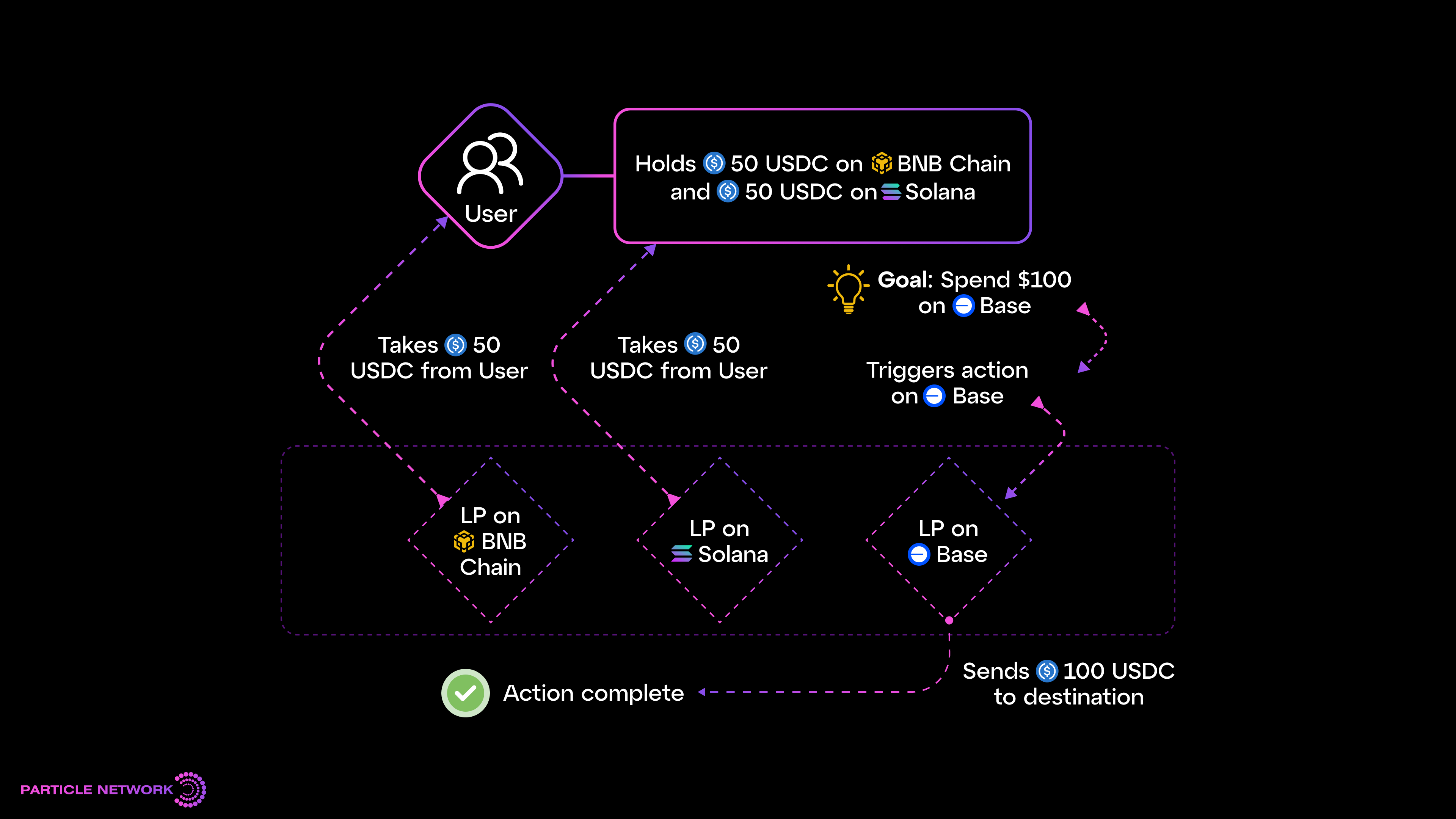
Universal Liquidity in action.
Gas Abstraction
Universal Liquidity also removes the requirement to hold native gas tokens on every chain. Paymasters cover gas fees on user’s behalf, then settle repayment afterward using any supported asset—even if that asset is on another chain. This looks as follows:- User signs to authorize the operation and repayment.
- Paymaster(s) fronts the gas immediately.
- The transaction is executed on the target chain.
- Repayment is deducted afterward using available balances.
TL;DR
Chain Abstraction, powered by Universal Liquidity, enables:- Assets across chains to function as a unified liquidity source.
- Execution of transactions using any combination of a user’s balances.
- Removal of bridging, gas concerns, and balance fragmentation.
Next Steps
Integrate Chain Abstraction
Start building with Universal Accounts.
See It Live: UniversalX
Try UniversalX, a chain-agnostic trading app powered by Universal Accounts.